
These functions can be used for generating random MIC values and disk diffusion diameters, for AMR data analysis practice. By providing a microorganism and antimicrobial drug, the generated results will reflect reality as much as possible.
Usage
random_mic(
  size = NULL,
  mo = NULL,
  ab = NULL,
  skew = "right",
  severity = 1,
  guideline = getOption("AMR_guideline", "EUCAST"),
  ...
)

random_disk(
  size = NULL,
  mo = NULL,
  ab = NULL,
  skew = "left",
  severity = 1,
  guideline = getOption("AMR_guideline", "EUCAST"),
  ...
)

random_sir(size = NULL, prob_SIR = c(0.33, 0.33, 0.33), ...)
Arguments
- size
Desired size of the returned vector. If used in a data.frame call or
dplyrverb, will get the current (group) size if left blank.- mo
Any character that can be coerced to a valid microorganism code with
as.mo(). Can be the same length assize.- ab
Any character that can be coerced to a valid antimicrobial drug code with
as.ab().- skew
Direction of skew for MIC or disk values, either
"right"or"left". A left-skewed distribution has the majority of the data on the right.- severity
Skew severity; higher values will increase the skewedness. Default is
2; use0to prevent skewedness.- guideline
A guideline name to base the generated values on, either
"EUCAST"(default) or"CLSI"for the latest implemented version, or a guideline including a year (e.g.,"CLSI 2019"). The default can be changed with the package optionAMR_guideline, seeas.sir().- ...
Ignored, only in place to allow future extensions.
- prob_SIR
A vector of length 3: the probabilities for "S" (1st value), "I" (2nd value) and "R" (3rd value).
Details
Internally, MIC and disk zone values are sampled based on the human clinical breakpoints of guideline in the clinical_breakpoints data set. To create specific generated values per bug or drug, set the mo and/or ab argument. The MICs are sampled on a log2 scale and disks linearly, using weighted probabilities. The weights are based on the skew and severity arguments:
skew = "right"places more emphasis on lower MIC or higher disk values.skew = "left"places more emphasis on higher MIC or lower disk values.severitycontrols the exponential bias applied.
Examples
random_mic(25)
#> Class <mic>
#> [1] 0.002 0.0005 0.125 0.0005 0.5 0.008 0.008 2 >=8 0.016
#> [11] 0.008 0.25 0.016 0.008 0.002 0.0002 0.0002 0.0002 0.125 0.001
#> [21] 1 0.125 0.5 0.002 0.016
random_disk(25)
#> Class <disk>
#> [1] 46 48 39 28 25 42 40 50 46 34 29 20 35 29 20 41 38 18 24 28 49 24 46 41 23
random_sir(25)
#> Class <sir>
#> [1] I R I S R I I R I S S I I R S I R I I S I I I R S
# add more skewedness, make more realistic by setting a bug and/or drug:
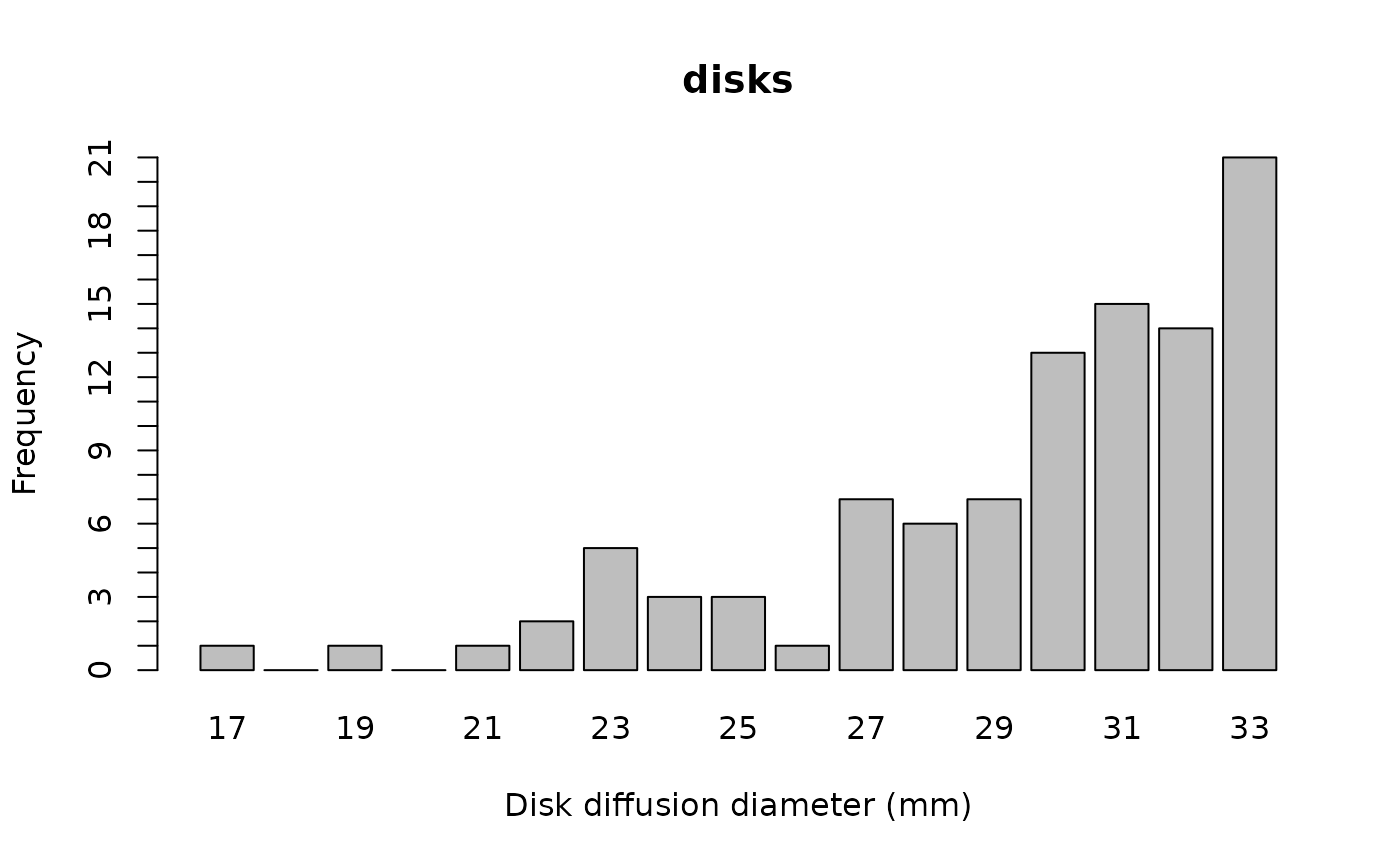
disks <- random_disk(100, severity = 2, mo = "Escherichia coli", ab = "CIP")
plot(disks)
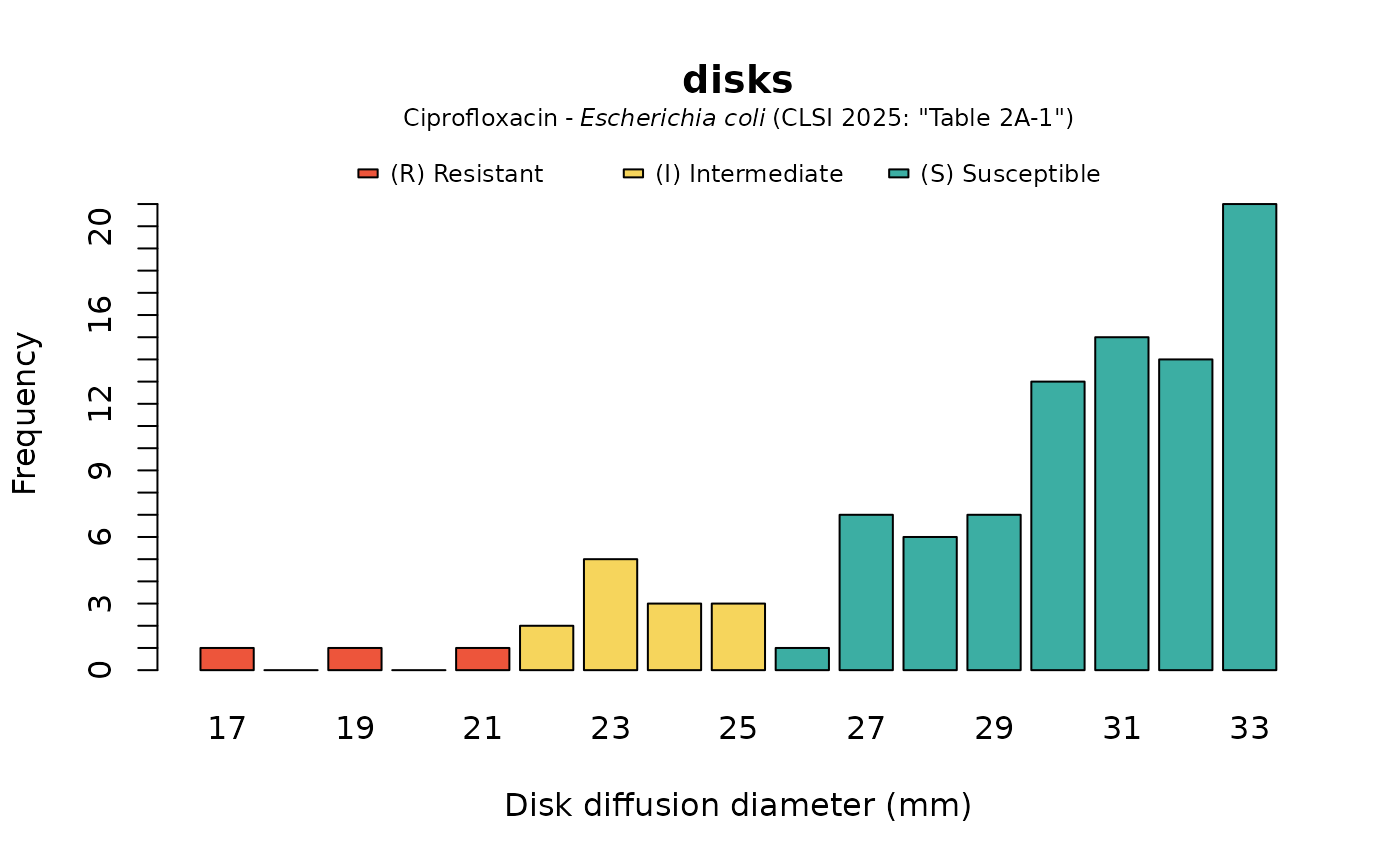
 # `plot()` and `ggplot2::autoplot()` allow for coloured bars if `mo` and `ab` are set
plot(disks, mo = "Escherichia coli", ab = "CIP", guideline = "CLSI")
 # \donttest{
random_mic(25, "Klebsiella pneumoniae") # range 0.0625-64
#> Class <mic>
#> [1] 4 0.001 0.004 0.0001 0.002 0.008 0.008 1 0.125 0.064
#> [11] >=16 0.002 0.0001 0.0002 0.0001 0.064 0.0002 0.001 0.002 0.0005
#> [21] 0.0005 0.016 0.004 0.0005 0.0005
random_mic(25, "Klebsiella pneumoniae", "meropenem") # range 0.0625-16
#> Class <mic>
#> [1] <=2 <=2 <=2 <=2 4 <=2 4 <=2 4 <=2 4 4 4 <=2 4 <=2 <=2 4 <=2
#> [20] 4 4 <=2 <=2 <=2 4
random_mic(25, "Streptococcus pneumoniae", "meropenem") # range 0.0625-4
#> Class <mic>
#> [1] <=0.064 <=0.064 <=0.064 0.25 <=0.064 0.25 <=0.064 <=0.064 0.25
#> [10] <=0.064 <=0.064 0.125 0.125 <=0.064 0.125 0.25 0.125 <=0.064
#> [19] 0.125 <=0.064 0.125 0.25 0.25 <=0.064 <=0.064
random_disk(25, "Klebsiella pneumoniae") # range 8-50
#> Class <disk>
#> [1] 27 15 20 29 32 34 27 24 23 22 32 31 26 34 32 20 12 26 25 30 25 23 23 20 22
random_disk(25, "Klebsiella pneumoniae", "ampicillin") # range 11-17
#> Class <disk>
#> [1] 17 18 15 17 18 17 18 13 17 17 13 15 15 16 15 15 14 16 14 14 13 17 18 14 17
random_disk(25, "Streptococcus pneumoniae", "ampicillin") # range 12-27
#> Class <disk>
#> [1] 18 27 18 24 23 24 25 24 27 15 19 18 25 25 24 26 27 25 24 20 26 27 28 24 23
# }